The Denominator Shift
A Practical Framework for Understanding AI-Driven Labor Compression

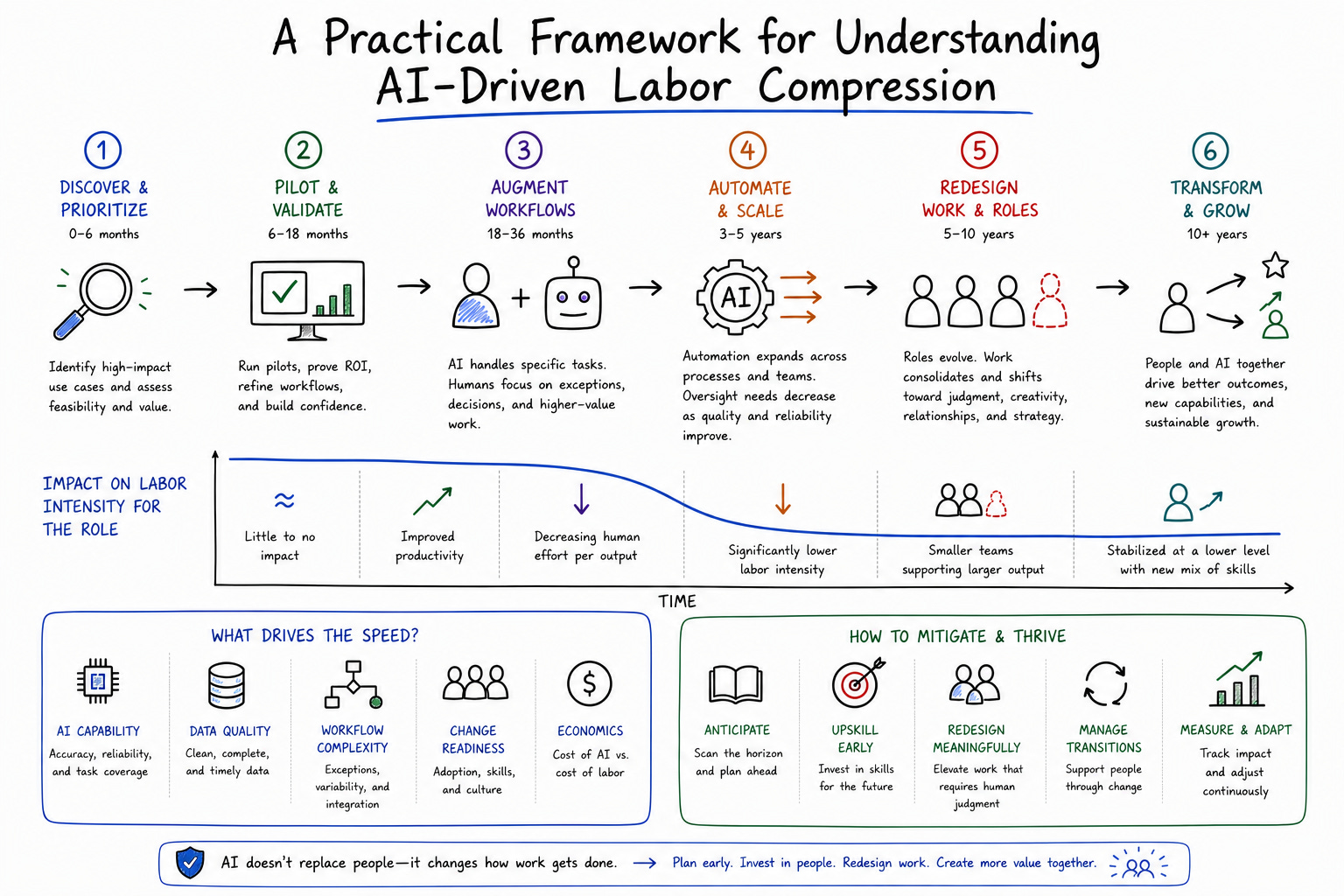
In my last piece, “Maximizing AI Value Without Minimizing Human Value,” I argued that the central challenge of the AI era is not simply capability expansion, but preserving human dignity, judgment, and meaning while institutions aggressively optimize for efficiency.
Since publishing it, I have found myself returning to a more operational question: What does AI-driven optimization actually look like inside organizations over time?Not in theory. Not in benchmark demos. Not in futurist abstractions. Inside real institutions trying to reduce cost, increase leverage, and maintain output under competitive pressure.
The more I observe AI adoption patterns across SaaS organizations, the more I believe we are measuring the wrong thing entirely. Most conversations about AI and labor still center around a simple question: “Will AI replace humans?”
The framing sounds intuitive, but operationally it misses what is actually happening inside many organizations right now. Institutions do not optimize for symbolic human presence. They optimize for output per unit cost. Which means the more important question is this: “How many humans are required per unit of institutional output?”
That is the denominator shift.
Once you start looking for it, the pattern becomes difficult to ignore. The visible shell of the organization remains intact. The company still has product managers, engineers, customer success teams, executives, support functions, and implementation teams. From the outside, the institution appears fundamentally unchanged. Customers still receive services. Products still ship. Revenue still flows. But underneath, the labor density begins changing. Fewer junior employees. Smaller apprenticeship layers. Increased contractor elasticity. More AI-mediated workflows. Higher concentrations of senior talent supporting larger operational surfaces. Stable or increasing output without proportional staffing growth.
What makes this difficult to recognize in real time is that traditional business metrics often continue looking healthy during the transition. Revenue may remain stable. Customers may remain stable. Institutional output may remain stable. In some cases, revenue per employee improves dramatically, reinforcing the perception that the organization is becoming more efficient and operationally mature. Yet internally, the institutional physics are changing.
To better reason about these shifts, I started developing a set of operational diagnostic metrics to support my own data driven curiosity. Not academically validated frameworks, but practical lenses for understanding what AI adoption is actually doing to labor structures inside modern organizations. These can and will evolve over time.
Metrics like:
Humans Required per Unit of Institutional Output (HRUIO) - a measure of labor density and how many humans are needed to sustain a defined level of organizational output
Capability per Dollar (CpD) - economically useful AI capability relative to total deployment and operational cost
Institutional Compression Rate (ICR) - the rate at which organizations reduce labor density while maintaining stable output
Pipeline Viability Index (PVI) - whether institutions are regenerating future senior talent fast enough to sustain long-term operational resilience
Coordination Load Reduction (CLR) - whether AI is actually reducing organizational friction, coordination overhead, and operational complexity rather than simply redistributing work
These metrics matter because they measure something traditional reporting often misses entirely: institutional resilience.
One pattern I am increasingly observing looks roughly like this:
An organization that once operated with several hundred employees and a meaningful junior workforce gradually compresses toward a much smaller core organization dominated by senior talent, supported by AI tooling and contractor flexibility. The ratio changes dramatically over time. What may have once looked like a healthy mix of senior and junior employees becomes a heavily senior-weighted organization with only a thin apprenticeship layer remaining beneath it. Initially, leadership often interprets this as success.
Labor costs decline. Revenue per employee rises. AI adoption appears to be working. Human leverage improves. The organization looks leaner, faster, and more disciplined from the outside.
But then something interesting happens…Velocity does not materially increase.
That observation is important because much of the current AI narrative implicitly assumes that efficiency gains naturally produce acceleration. In practice, I am increasingly seeing organizations compress labor density significantly while only preserving output rather than meaningfully expanding it. That distinction matters enormously. Because once you look deeper, the constraint often shifts from raw labor capacity to institutional coordination and knowledge transfer.
Senior employees become bottlenecks. AI-generated outputs require validation and review. Contractor dependency increases. Institutional memory becomes fragmented across systems and external contributors. Fewer junior employees absorb operational throughput or develop into future organizational leaders. Succession pipelines weaken.And this is where the Pipeline Viability problem emerges.
I increasingly believe this may be one of the most important structural issues hidden underneath current AI transformation narratives. Institutions regenerate themselves through apprenticeship layers. Junior engineers become senior engineers. Associates become partners. Analysts become directors. Residents become attending physicians. Junior product managers become organizational operators capable of carrying institutional context across years of strategic evolution.
When the junior layer collapses, the institution may continue functioning for a long time because accumulated expertise still exists inside senior workers. From the outside, everything appears stable. But over time, the organization begins consuming institutional knowledge faster than it regenerates it. Traditional business metrics rarely capture this dynamic well. You can simultaneously have stable revenue, stable customers, acceptable delivery performance, improving revenue per employee, and still be quietly degrading long-term institutional resilience underneath the surface.That is why I find the denominator shift framing so useful. It explains why intelligent people can look at the same environment and reach completely different conclusions about AI.
One person says, “Humans are still everywhere.” Another says, “Yes, but look at the labor density.” Both observations are true.
The visible profession survives while the ratios underneath change.
And importantly, this does not necessarily produce immediate mass unemployment. The more likely near-term pattern is subtler and potentially more destabilizing over time: thinner organizations, shrinking entry pathways, concentrated expertise, delayed career mobility, and fewer humans required to sustain institutional output.
That last point is the one I keep coming back to. The economy can continue functioning while labor necessity steadily declines underneath it. I increasingly suspect that may become one of the defining economic dynamics of the increasingly AI native world in which we live.